As something of a connoisseur of creepy things with lots of legs, you can imagine how exited I was when a member of my knitting forum posted about two odd creatures she'd found in the mouth a snapper she's just cooked (I was in fact so excited it took me a couple of months to get around to blogging about it, but that's purely a reflection of my disorganisation rather than the awesomeness of the find). I won't say it's the coolest thing I've ever seen in that forum, because it also introduced me to Fatty Thor, but it came pretty damn close. The knitter who found it doesn't want to be identified in case she is forever known as Snapper Tongue Louse Girl, but she was kind enough to send me some high resolution pictures of them which I've put behind a link because I know that my Dad sometimes reads this blog and I suspect he'd never eat again if he saw them.
Picture 1
Picture 2
So what are these marvelous mouth monsters? They're female and male Cymothoa exigua, known to their friends as the tongue eating louse, and look only slightly less terrifying when not baked in a salt crust. This aquatic distant relative of the woodlouse glories in the distinction of being the only parasite known to functionally replace the organ it destroys - the female (the larger of the two nightmarish nibbles in the pictures) enters the fish's mouth through the gill slits and eats the helpless creature's tongue, then using her pincers attaches herself to the stump and spend the rest of her life serving as a replacement, living on food and mucus in the fish's mouth. The smaller of the two, romantically roasted with her, is the male who would have been clinging to the gills in the hope of a bit of tongue action.
All in all you might think that after going through all that, being baked in a salt crust probably came as a blessed relief for the poor red snapper, so I'll leave it to Bec Crew to explain how having an alien in its mouth could have been an advantage if the fish was shy talking to the lady snappers.
Friday, 25 January 2013
Tuesday, 25 December 2012

Monday, 17 December 2012
Wshing you all a creepy crawly Christmas!
And here's a suggestion for a last minute educational Christmas present for kids and adults who think they're kids: an Incredible Arthropods colouring book from The Bug Chicks:

There's still just about time to order it in the US or UK and it's guaranteed educational, doesn't require batteries and doesn't make an annoying noise.
It's also available as a digital download, allowing you to print the pictures on transparencies and stick them on your window - if you colour them with Sharpies they looks like stained glass when the sun shines in and scare your naighbours after dark when the light shines out.
If you don't have access to transparencies you can also make cool stained glass by tracing the pictures onto greaseproof paper, or make shrinkable art to make jewellery or button badges by tracing the pictures onto food containers then cutting them out and baking them in the oven. Do make sure you use the right type of plastic though, you want number 6.
 Happy Christmas!

There's still just about time to order it in the US or UK and it's guaranteed educational, doesn't require batteries and doesn't make an annoying noise.
It's also available as a digital download, allowing you to print the pictures on transparencies and stick them on your window - if you colour them with Sharpies they looks like stained glass when the sun shines in and scare your naighbours after dark when the light shines out.
 |
| Why yes, London is cold, grey and miserable |

Wednesday, 12 December 2012
What is Chemical Ecology?
One striking thing that I realised from the discussions about Rothamsted’s wheat trial is how little was known about chemical ecology - it’s
very easy to get so absorbed in your own field that you forget that what you’re
working on isn’t common knowledge in the wider world. It’s also a fascinating example of how words
can have very different associations to different people – to me chemical
ecology is a fascinating field of study, but I actually noticed one protestor I
was talking to recoil in horror at the juxtaposition of the friendly, positive
word “ecology” with the word “chemical”, with all its unnatural connotations.
Colloquially, the word “chemical” has come to mean something
artificial, some unpronounceable synthetic substance with unpredictable effects
cooked up in a lab somewhere, but it’s important to realise that in the
technical sense the word chemical simply means a collection of atoms. Using the technical definition every physical
object we encounter is made up of chemicals – water is a chemical, so is the
oxygen we breathe, the vitamins, sugars and proteins that we eat, the keratin
in our hair. (The fact that this field
of study was named something that seems so off-putting to some perhaps just
goes to show that science doesn’t have access to the sort of slick PR machine
many assume it does!).
The science of ecology involves the study of the
relationships between different organisms, and between organisms and their environment. Chemical ecology is a particular subsection
of this discipline, which studies those interactions that are mediated by
chemicals; semiochemicals which convey information, for example smelly
compounds which alert organisms to the presence of suitable or unsuitable food,
mates, or danger, pheromones which allow individual organisms of the same
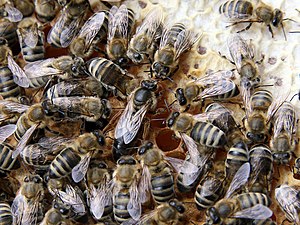
species to coordinate behaviour (for example the queen mandibular pheromone of
honey bees that prevents workers from laying eggs),
and defensive compounds that species use to wage chemical warfare on one
another – the formic acid wood ants squirt at attackers, the antibiotics
secreted by some fungi to prevent the growth of competitor bacteria on their
food or the
signals used by the parasitic weed Striga to parasitise its host plant
for example.
 |
| Queen bee surrounded by workers, image from Wikipedia. |
My own research on the smells that attract the fly that transmits trachoma to the tears it feeds on and the faeces it lays its
eggs on, and so the aspect of chemical ecology I’m most familiar with, involves
semiochemicals – the volatile molecules that diffuse through the air and convey
information to the creatures that smell them.
These are often oil-soluble chemicals – if you try to think of some of
the strongest smelling things you encounter aromatherapy oils are probably on
the list somewhere – but they can also be things that humans can’t smell, like
carbon dioxide or water. Insects in
general have very acute sense of smell – a bee,
for example can smell the equivalent of a single grain of salt in an
Olympic-sized swimming pool. (This highly
acute sense of smell, incidentally, is why bees are being trained to sniff out
drugs and explosives.) So if you’re
hoping to learn how insects interact with their world, and maybe to control how
they do so, smell is a good place to start.
Sniffer bees in action
There are various ways to find the odours insects can
detect, but one of the most direct is to eavesdrop on what’s going on in their
brains using a technique called electroantennography. A nerve impulse is fundamentally just a spike
of electrical charge, so by very carefully inserting one electrode into the tip
of an insect’s antenna, and another into the area of an insect’s brain
responsible for smell, you can measure how the difference in charge between the
two electrodes varies when the insect is exposed to different smells you think
might be important to it and by doing so find out which ones trigger a nerve
impulse – which ones it’s smelling. From
there you can go on to do laboratory and field tests to find out how the insect
reacts to these smells; does it fly towards them, away from them, or do
something in response to them, like feeding on what smells like tasty food or
laying eggs on what smells like a good place for its young to develop?
Exploiting an insect’s sensory word has one great
advantage over many other pest control methods – as different smells mean
different things to different insects, taking an approach informed by chemical
ecology allows you to target one particular pest species without affecting
others, unlike blanket insecticides for example which may be just as harmful to
beneficial insects or a pest’s natural predators as they are to the pest
itself. Take the coddling moth for example, a pest of apple trees whose caterpillar
is the traditional “worm in the apple”.
 |
| Coddling moth larva damage, from Wikipedia. |
Adult females of this species produce a
characteristic pheromone which the male can smell from a great distance away,
and he can then follow the perfume trail to find her and mate. Instead of spraying orchards with insecticide
farmers can now use traps baited with synthetic versions of this pheromone in a
technique called mating disruption – overwhelmed by the strong perfume wafting
from the traps the male can no longer find the female, they both eventually die
alone and frustrated and the apples are protected.
The coddling moth isn’t the only insect species whose
chemical communication can be its downfall.
Contrary to popular belief bedbugs don’t actually live in bedlinen, but
spend the day hiding in “refuges”, cracks in walls or furniture. Dozens huddle together in these refuges,
waiting out the day, and find each other using their characteristic smell,
sometimes described as reminiscent of cilantro or coriander (although I won’t
be sprinkling bedbugs on my Thai curry any time soon). They’re not the only ones who can use this
smell though – bedbug infestations mean big business losses for hotels so they
need to be tipped off at the first sign of infection. The most sophisticated bedbug detectors out
there use the smell that bedbugs produce to find them, and then signal that
they’ve done so...by wagging their tails.
 |
| Bed bug detection dog |
That’s right, the best bedbug detectors out there are
dogs. Well, the sniffer dogs need
something to do if the bees are displacing them at airports.
In Kenya a novel farming system exploiting chemicalecology is being pioneered to control stem borer caterpillars. These are the larvae of a number of different
moth species (Chillo partellus, Eldana saccharina, Busseola fusca, Sesmia
calamistis) that basically do exactly what they say on the tin; chomp their way
through the stems of maize plants, boring out the centres, which obviously
doesn’t do a lot of good to either the maize or the farmers who want to eat it. The moths find the maize plant to lay their
eggs on by smell, and that’s where chemical ecology comes in, using a push-pull
strategy of interplanting a plant that smells repellent to the moths with the
maize, to mask its naturally attractive smell, and surrounding the maize crop
with a plant that smells attractive to the moths to lure them away. Cunningly the repellent-smelling intercrop is
a plant called Desmodium, a member of the bean family that enriches the soil
with nitrogen and as a bonus kills the parasitic weed Striga which also reduces
maize yields, and the attractive plant is a grass which can be fed to cattle
and which traps the stemborers with sticky sap.
An understanding of chemical ecology isn’t just
helpful for plant growing either. Kenyan
cattle herders dread nagana, a
disease spread by tsetse flies which causes weightloss and death in their
herds. Attractant traps for tsetse flies
already exist – blue sheets (a colour that the flies find attractive) baited
with carbon dioxide mimicking the exhaled breathe of the animals tsetses feed
on. (Incidentally this is why tsetse flies chase cars: a tsetse’s prey is a
large moving object breathing out carbon dioxide, and a car is a very large,
fast-moving object pumping out large amounts of carbon dioxide).
 |
| Tsetse trap, from Wikipedia |
But these traps alone aren’t sufficient to protect
the Kenyan cattle herds. The solution
came in the form of repellent collars for the cattle, which mimic the odour of
animal species that tsetse don’t find attractive. These are being rolled out at the moment and, in conjunction with traps, serve as a push-pull system for the tsetse.
How about insects pests that transmit human diseases,
could chemical ecology be used to control them?
It’s a possibility. Like tsetse
flies, mosquitoes are attracted to the carbon dioxide in exhaled breath, and
also to various odorous chemicals evaporating from human skin. We may already have something that could
serve as the pull component of a push pull system – a trap baited with carbon
dioxide and a synthetic blend of these chemicals that could be more attractiveto mosquitoes than humans are, and we’re on our way to
develop a push.
At present the only effective wearable mosquito
repellent is DEET, developed by the US military
to protect its soldiers. Although highly
effective it has its drawbacks, sometimes causing irritation or damaging
clothes. Repellents made from lemon eucalyptus look promising but evaporate too quickly from the skin to
be very useful at the moment. The
solution may lie in chemicals that we ourselves produce naturally – it turns
out that as well as the attractive chemicals we all produce some of us also produce natural mosquito repellents.

This is not in fact an oven ready scientist but me in
a survival bag. These are used to
capture the odours that human beings produce, to analyse for chemicals that are
attractive or repellent to mosquitoes, as they’re airtight and have very few
odours of their own. Air that has had
all its own odours purified out with a charcoal filter is blown into the bag,
and the, umm, miasma sucked out and analysed.
Maybe someday we’ll be able to use these odours to make everyone smell
utterly repellent, at least to mosquitoes.
Using chemical ecology to study the stimuli useful to
insects gives us a greater understanding of the world from their perspective,
and the more we understand about what chemical information they use to find
resources important to them the more we can manipulate those resources that are
also useful to us, like crop plants or even our own bodies, to reduce the
conflict between us. In an increasingly
resource-constrained world, gaining a better understanding of natural systems
in order to make fewer, more sophisticated changes to better meet our needs is
surely the way to go.
Wednesday, 31 October 2012
This Halloween, meet the vampire maggot!
Happy Halloween! Say hello to the blood-sucking larva of Auchmeromyia senegalensis.
This little chap lives in Subsaharan Africa, in dirt floors and bedlinen, and crawls out at night to suck sleepers' blood. Unlike fictional vampires he doesn't sparkle, but like certain fictional vampires he's not especially bright and is utterly defeated if sleepers are raised off the group on beds (he evolved to feed on burrowing mammals). Although he seems like a fairly uncharismatic creature, research into other bloodsuckers like leeches has already yielded a natural anticoagulant so who knows what tricks this under-researched vampire may be using to get his dinner?
Sleep tight.

 |
| Image pinched from Bogleech's brilliant "Top Twenty Coolest Flies" |
Sleep tight.

Sunday, 27 May 2012
Protests in the Park
 | ||
| Badges! |
It was rather surreal to walk into Rothamsted Park around eleven thirty on a brilliantly sunny day to see chestnut trees in bloom, families walking dogs and a massive police presence. Members of both the anti-gm protest and the pro-research counterprotest had already arrived and assembled in their separate camps at the back of the park, and after a slightly confused few minutes during which I attempted to join the wrong group I found the counterprotest and started putting a few faces to Twitter handles.
 |
| Police horses looking cool in sunglasses |
Although after the media briefing Rothamsted scientists had originally planned to talk to Take the flour back in the park, with their refusal to rule out destructive measures it was considered best for them to stay behind the police line and for protestors to be escorted to them in small groups. Sadly there didn't seem to be much interest in discussions with them, an attitude I encountered myself when I asked for a right of reply to the speeches which contained some misinterpretations (the trial was asserted to be useless because it was carried out in spring wheat wheareas winter wheat which is more widely grown in the UK, and I would have likeld the opportunity to explain that it was only a proof of concept trial, rather than a trial of the final variety) and some outright misunderstandings (the incorrect statement that the wheat contains a gene from cows, the claim that gm crops were directly responsible for the suicides of thousands of farmers in India). I was told in no uncertain terms by the chap directing the speakers that they didn't want to listen because they'd already heard everything I would have to say in the media. I found this a rather depressing attitude - so many of the speakers were repeating completely unverifiable or downright untrue claims and I thought it was sad that they weren't willing to consider the evidence for and against these claims. I know I keep linking to this blog post but it's an excellent discussion of the perceptual filters that colour our view of the world - surely the only way to become aware of and evaluate the distorting effect of these filters is to be willing to consider the evidence for and against your poistion?
I have to admit that by this point I was feeling rather dispirited, and as nothing much seemed to be happening at this point I went off in search of lunch (the biggest winner of the day was probably the Harpenden Farmers' Market, which was doing a roaring trade to members of both groups) with a couple of other protestors. This proved to be a slight tactical miscalculation as just as we got back to the park the anti-gm group flocked towards the Rothamsted fence, forcing us geeks, already weakened by exposure to sunlight, to break into a run.
 |
| Anti-gm protestors assemble by the fence. |
 |
| Protestors attempting to enter the site are turned away by police |
We then initiated our own sit down, chow down protest and ate our lunch and it was at that point that things started to get interesting. Until that point all our attempts at initiating dialogue had been rebuffed, but at this point people started coming up to us to talk. One woman was extremely angry and delivered a lecture on how transgenes could contaminate the soil and the rain before storming away, followed by her tweenage son who clearly wished he was somewhere else, but we did speak to a fair number of people interested in genuine conversations about their concerns and in finding common ground. Discussions with a group of Permaculture students from Bristol were particularly fascinating, and certainly helped me to get a better understanding of peoples' concerns.
What I think I took away from this was that there are three main strands of concerns about genetic modification:
- The idea that genomes are sacrosanct and any movement of genes between organisms is unacceptable meddling with nature. As a scientist familiar with natural examples of gene transfer between organisms this isn't a position I can agree with, indeed I consider it to be amazing evidence of how connected all organisms are, but I can understand that it is an article of faith for some people and, like religious faith, not really amenable to change by debate.
- Concerns over the safety of gm crops, both to the environment and to human health. This is an area where I really feel we can challenge misinformation, as these claims are verifiable by empirical evidence rather than personal belief. The challenge is to ensure the evidence isn't disbelieved because of concerns about the biases or hidden agenda of the person presenting it, but by being open and honest throughout the process I hope we can combat these impressions.
- Concerns about the application and commercialisation of gm crops. Although my opinion of the necessity of the fundamental research hasn't changed, one positive consequence of these discussions is that I've learned a lot about the issues involved in this. To my mind this is an argument for campaigning to ensure that legislation catches up with the technology that has run ahead, rather than for slowing the technology down, but it certainly has made me think harder about how scientific advances are likely to be implemented, rather than simply how they occur.
Friday, 25 May 2012
Guidelines for protest in Rothamsted park
THIS POST IS MY PERSONAL OPINION AND NOT ENDORSED BY ROTHAMSTED. ROTHAMSTED WOULD RATHER NOT HAVE A PROTEST OR COUNTER PROTEST AT ALL, BUT THIS HAS GATHERED SO MUCH MOMENTUM ON TWITTER NOW I THINK IT'S INEVITABLE AND WE SHOULD START THINKING ABOUT HOW TO MAKE SURE EVERYTHING STAYS CIVIL.
It looks as though there will now be three protests happening in Rothamsted Park on Sunday the 27th of May - the anti-gm protest which aims to destroy the field trial, an alternative peaceful protest which wants to express oposition to genetic modification without vandalising the trial and a #geekmob counterprotest in support of the trial. To the first group I would obviously say please don't, but I hope something positive can come out of this by offering an opportunity for dialogue between the second two groups if everyone follows these guidelines:
Thank you.
A team
of Rothamsted scientists will be at Rothamsted Park, Harpenden AL5 2EF
to answer questions from 11.30 on Sunday the 27th of May - do go and talk to them,
they're nice people.
If you're coming from London, when you get off the train go out the station exit to the left of the direction you were travelling, then follow the hill down. There's a pub on the corner called the Harpenden Arms - turn left after that, cross at the crossing, cross the green then follow the road to the left. The entrance to the park is just after the town hall/
If you're coming from London, when you get off the train go out the station exit to the left of the direction you were travelling, then follow the hill down. There's a pub on the corner called the Harpenden Arms - turn left after that, cross at the crossing, cross the green then follow the road to the left. The entrance to the park is just after the town hall/
- There aren't many trains into Harpenden, so you'll probably end up travelling with members of the other camp. This is a great opportunity for dialogue but please remember there'll be other passengers on the trains who just want to nurse their Saturday night hangovers in peace so please keep it calm.
- By all means bring placards, banners, pixel poi and Arduino LED displays but keep the messages attacking points not people. "Down with this sort of thing" is good, "your muzzer was an amstere, and your fazzer smelled of elderbereees" is not helpful.
- The same goes for engaging people in discussion - remember that the person you're talking to may not have the same grounding in the subject you do or access to the same information, but they're an intelligent person doing what they sincerely believe to be best for planet and people. As an entomologist I'm not so keen on the phrase "you catch more flies with honey than with vinegar" - vinegar will work perfectly well if you're after vinegar flies, and you catch most Musca sorbens with shit which doesn't make a very good cliche, but it is true that if someone is wrong you're more likely to change their mind through rational argument than by insulting their intelligence.
- Listen. Let the other person explain their concerns.
- If someone isn't extending you the same courtesy, walk away. You will not be able to have a productive discussion.
- If things are getting heated, and you feel safe doing so, you can deescalate the situation by sitting down.
- Do not attempt to physically prevent anyone from destroying crops. Not only might this lead to ugly confrontations, the more people there are on the site the harder it will be for the police to stop people intent on destroying the trial and the more likely it is that something important will be trampled accidentally.
- Finally, and most importantly, PLEASE DON'T DESTROY THE TRIAL..
Thank you.
Subscribe to:
Posts (Atom)