Entomology, chemical ecology, evidence-based environmentalism and science in general. I like big bugs and I cannot lie.
Showing posts with label Pest management. Show all posts

Monday, 3 March 2014

Ticked off at the news

Today I heard the sad news that the Borreliosis and Associated Diseases Awareness UK charity is ceasing operation as a charity due to lack of funds. We in the UK are comparatively lucky in vector-borne disease stakes, able to enjoy the great outdoors without too much concern about being bitten by something that'll give us something 'orrible, but one that we do have to deal with is Lyme disease which along and its relatives, transmitted by the bites of ticks which contrary to popular belief are arachnids not insects. Lyme disease can be debilitating (as is shown by my friend's blog about living with it) and it is still often initially not correctly diagnosed, which is why the campaigning work of BADA UK has been so vital and their closure is such a tragic loss particularly now that the incidence of Lyme disease appears to be on the increase.

This campaigning was so important because there is a lot of misinformation out there about ticks and the diseases they transmit, and not just this sort of thing:


I spend more time on Pinterest than I probably should and I've encountered some quite horrifying pins describing this one weird trick some [nurse/mom/other trustworthy-sounding person] has discovered to remove ticks. Needless to say the vast majority of them are a very bad idea, which is a serious problem as incorrect removal can increase chances of disease transmission. Fortunately some colleagues of mine recently published a review paper on best practice:


Avoiding ticks


Encouragingly a randomised controlled trial showed that infections were less common in people who received education about ticks. Congratulations, by reading this post you've just joined the lucky group! The best way of preventing disease transmission is not to get bitten in the first place. Cover up: wear  trousers and tuck them into you socks - I know it looks daft but you can always pretend you're Tintin.  And if you're feeling really fancy you can even get clothes impregnated with the insecticide permethrin which has bee shown to be effective in reducing the incidence of tick bites, although it does need retreating frequently to remain effective.

Everyone's favourite racist, cultural imperialist boy reporter.
The next line of defense is to use a repellant, a substance that beasties find unpleasant smelling that you can rub on your skin to put them off their lunch. Trans-p-methane-3,8-diol (PMD), or lemon eucalyptus oil to its friends, has been shown to be highly repellent toward ticks and in laboratory studies was still providing some protection 48 hours later. By contrast there is little evidence for the effectiveness of DEET against ticks, and what evidence there is seems to suggest it only has a short-term effect. (It should be noted that this is different from the situation for mosquitoes, against which DEET offers better protection).

Tick removal

The faster you can remove a tick, the less chance it will have to get bacteria into your bloodstream. Check yourself every few hours for ticks, and - waggles eyebrows suggestively -see if you can find a tick buddy to check the areas you can't see yourself (or more boringly use a mirror).

Tick removal is the step that seems to have produced the most dangerous home remedies.  Trying to suffocate the ticks with petroleum jelly, nail polish or rubbing alcohol is likely to be ineffective as ticks respire very slowly so can keep feeding without air long enough to infect you, and if you do manage to damage or kill a tick by one of these methods or using a lighted match there's a danger that parts of it will be left in your skin, posing an infection risk. (Needless to say combining rubbing alcohol and a lighted match would be a terrible idea.) BADA has an excellent series of photographs demonstrating correct removal on their very informative website, which will remain active until December 2015: using tweezers, and using a specialist removal tool. At present the evidence in humans suggests that the safest method of tick removal in humans is to use fine-tipped tweezers - evidence for the effectiveness of the tick removal tool only comes from veterinary medicine.  However, if you're not comfortable with tweezers the removal tool is probably a better bet than any of the other methods out there. The TickTwister tool is available to buy here.

If you've been bitten


Although the characteristic bull's eye rash is probably the best known Lyme disease symptom, it only appears in around 60% of patients.  Other symptoms include:
  • unexplained headaches and neck stiffness, 
  • flu-like symptoms,
  • facial palsy, 
  • arthralgia
  • heart palpitations, 
  • dizziness 
If you experience any of these within a few weeks of being bitten by a tick, or of being somewhere you know ticks are present even if you didn't notice a bite, you should see a doctor.

PLEASE NOTE THAT I AM NOT MEDICAL DOCTOR, I'M JUST SOME WEIRDO ON THE INTERNET WHO LIKES POKING THINGS WITH MORE LEGS THAN ME. IF YOU THINK YOU HAVE ANY OF THESE SYMPTOMS I CAN'T CONFIRM THIS OR DIAGNOSE YOU, YOU WILL NEED TO SEE YOUR GP.


Bull's eye rash, from BADA
Your GP should be able to carry out further tests, and prescribe a course of prophylactic antibiotics if necessary.

So get out there and enjoy the countryside, but respect it too: even here in the UK we have disease vectors that could make you very sick if you give them a chance!
Wednesday, 12 December 2012

What is Chemical Ecology?


One striking thing that  I realised from the discussions about Rothamsted’s wheat trial is how little was known about chemical ecology - it’s very easy to get so absorbed in your own field that you forget that what you’re working on isn’t common knowledge in the wider world.  It’s also a fascinating example of how words can have very different associations to different people – to me chemical ecology is a fascinating field of study, but I actually noticed one protestor I was talking to recoil in horror at the juxtaposition of the friendly, positive word “ecology” with the word “chemical”, with all its unnatural connotations.

Colloquially, the word “chemical” has come to mean something artificial, some unpronounceable synthetic substance with unpredictable effects cooked up in a lab somewhere, but it’s important to realise that in the technical sense the word chemical simply means a collection of atoms.  Using the technical definition every physical object we encounter is made up of chemicals – water is a chemical, so is the oxygen we breathe, the vitamins, sugars and proteins that we eat, the keratin in our hair.  (The fact that this field of study was named something that seems so off-putting to some perhaps just goes to show that science doesn’t have access to the sort of slick PR machine many assume it does!).

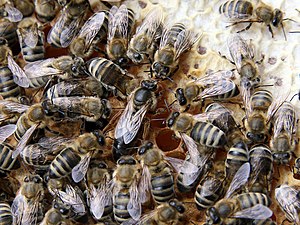
The science of ecology involves the study of the relationships between different organisms, and between organisms and their environment.  Chemical ecology is a particular subsection of this discipline, which studies those interactions that are mediated by chemicals; semiochemicals which convey information, for example smelly compounds which alert organisms to the presence of suitable or unsuitable food, mates, or danger, pheromones which allow individual organisms of the same species to coordinate behaviour (for example the queen mandibular pheromone of honey bees that prevents workers from laying eggs), and defensive compounds that species use to wage chemical warfare on one another – the formic acid wood ants squirt at attackers, the antibiotics secreted by some fungi to prevent the growth of competitor bacteria on their food or the signals used by the parasitic weed Striga to parasitise its host plant  for example.

Queen bee surrounded by workers, image from Wikipedia.
 
My own research on the smells that attract the fly that transmits trachoma to the tears it feeds on and the faeces it lays its eggs on, and so the aspect of chemical ecology I’m most familiar with, involves semiochemicals – the volatile molecules that diffuse through the air and convey information to the creatures that smell them.  These are often oil-soluble chemicals – if you try to think of some of the strongest smelling things you encounter aromatherapy oils are probably on the list somewhere – but they can also be things that humans can’t smell, like carbon dioxide or water.  Insects in general have very acute sense of smell – a bee, for example can smell the equivalent of a single grain of salt in an Olympic-sized swimming pool.  (This highly acute sense of smell, incidentally, is why bees are being trained to sniff out drugs and explosives.)  So if you’re hoping to learn how insects interact with their world, and maybe to control how they do so, smell is a good place to start.

 Sniffer bees in action

There are various ways to find the odours insects can detect, but one of the most direct is to eavesdrop on what’s going on in their brains using a technique called electroantennography.  A nerve impulse is fundamentally just a spike of electrical charge, so by very carefully inserting one electrode into the tip of an insect’s antenna, and another into the area of an insect’s brain responsible for smell, you can measure how the difference in charge between the two electrodes varies when the insect is exposed to different smells you think might be important to it and by doing so find out which ones trigger a nerve impulse – which ones it’s smelling.  From there you can go on to do laboratory and field tests to find out how the insect reacts to these smells; does it fly towards them, away from them, or do something in response to them, like feeding on what smells like tasty food or laying eggs on what smells like a good place for its young to develop?

Exploiting an insect’s sensory word has one great advantage over many other pest control methods – as different smells mean different things to different insects, taking an approach informed by chemical ecology allows you to target one particular pest species without affecting others, unlike blanket insecticides for example which may be just as harmful to beneficial insects or a pest’s natural predators as they are to the pest itself. Take the coddling moth for example, a pest of apple trees whose caterpillar is the traditional “worm in the apple”.

Coddling moth larva damage, from Wikipedia.

Adult females of this species produce a characteristic pheromone which the male can smell from a great distance away, and he can then follow the perfume trail to find her and mate.  Instead of spraying orchards with insecticide farmers can now use traps baited with synthetic versions of this pheromone in a technique called mating disruption – overwhelmed by the strong perfume wafting from the traps the male can no longer find the female, they both eventually die alone and frustrated and the apples are protected.

The coddling moth isn’t the only insect species whose chemical communication can be its downfall.  Contrary to popular belief bedbugs don’t actually live in bedlinen, but spend the day hiding in “refuges”, cracks in walls or furniture.  Dozens huddle together in these refuges, waiting out the day, and find each other using their characteristic smell, sometimes described as reminiscent of cilantro or coriander (although I won’t be sprinkling bedbugs on my Thai curry any time soon).  They’re not the only ones who can use this smell though – bedbug infestations mean big business losses for hotels so they need to be tipped off at the first sign of infection.  The most sophisticated bedbug detectors out there use the smell that bedbugs produce to find them, and then signal that they’ve done so...by wagging their tails.

Bed bug detection dog

That’s right, the best bedbug detectors out there are dogs.  Well, the sniffer dogs need something to do if the bees are displacing them at airports.

In Kenya a novel farming system exploiting chemicalecology is being pioneered to control stem borer caterpillars.  These are the larvae of a number of different moth species (Chillo partellus, Eldana saccharina, Busseola fusca, Sesmia calamistis) that basically do exactly what they say on the tin; chomp their way through the stems of maize plants, boring out the centres, which obviously doesn’t do a lot of good to either the maize or the farmers who want to eat it.  The moths find the maize plant to lay their eggs on by smell, and that’s where chemical ecology comes in, using a push-pull strategy of interplanting a plant that smells repellent to the moths with the maize, to mask its naturally attractive smell, and surrounding the maize crop with a plant that smells attractive to the moths to lure them away.  Cunningly the repellent-smelling intercrop is a plant called Desmodium, a member of the bean family that enriches the soil with nitrogen and as a bonus kills the parasitic weed Striga which also reduces maize yields, and the attractive plant is a grass which can be fed to cattle and which traps the stemborers with sticky sap.

An understanding of chemical ecology isn’t just helpful for plant growing either.  Kenyan cattle herders dread nagana, a disease spread by tsetse flies which causes weightloss and death in their herds.  Attractant traps for tsetse flies already exist – blue sheets (a colour that the flies find attractive) baited with carbon dioxide mimicking the exhaled breathe of the animals tsetses feed on. (Incidentally this is why tsetse flies chase cars: a tsetse’s prey is a large moving object breathing out carbon dioxide, and a car is a very large, fast-moving object pumping out large amounts of carbon dioxide).

Tsetse trap, from Wikipedia
But these traps alone aren’t sufficient to protect the Kenyan cattle herds.  The solution came in the form of repellent collars for the cattle, which mimic the odour of animal species that tsetse don’t find attractive.  These are being rolled out at the moment and, in conjunction with traps, serve as a push-pull system for the tsetse.

How about insects pests that transmit human diseases, could chemical ecology be used to control them?  It’s a possibility.  Like tsetse flies, mosquitoes are attracted to the carbon dioxide in exhaled breath, and also to various odorous chemicals evaporating from human skin.  We may already have something that could serve as the pull component of a push pull system – a trap baited with carbon dioxide and a synthetic blend of these chemicals that could be more attractiveto mosquitoes than humans are, and we’re on our way to develop a push.

At present the only effective wearable mosquito repellent is DEET, developed by the US military to protect its soldiers.  Although highly effective it has its drawbacks, sometimes causing irritation or damaging clothes.  Repellents made from lemon eucalyptus look promising but evaporate too quickly from the skin to be very useful at the moment.  The solution may lie in chemicals that we ourselves produce naturally – it turns out that as well as the attractive chemicals we all produce some of us also produce natural mosquito repellents. 


This is not in fact an oven ready scientist but me in a survival bag.  These are used to capture the odours that human beings produce, to analyse for chemicals that are attractive or repellent to mosquitoes, as they’re airtight and have very few odours of their own.  Air that has had all its own odours purified out with a charcoal filter is blown into the bag, and the, umm, miasma sucked out and analysed.  Maybe someday we’ll be able to use these odours to make everyone smell utterly repellent, at least to mosquitoes.

Using chemical ecology to study the stimuli useful to insects gives us a greater understanding of the world from their perspective, and the more we understand about what chemical information they use to find resources important to them the more we can manipulate those resources that are also useful to us, like crop plants or even our own bodies, to reduce the conflict between us.  In an increasingly resource-constrained world, gaining a better understanding of natural systems in order to make fewer, more sophisticated changes to better meet our needs is surely the way to go.


Wednesday, 25 August 2010

Dangers at dusk: is it time to move beyond bednets?

I originally wrote this for The Guardian's "Write the World" International development journalism competition. You can see the winning pieces here, some of which are excellent. I'd particularly recommend "Aid: Dead or alive?" for a more balanced discusion of the benefits and pitfalls of western aid than you usually find in the papers.

Cattle amble lazily back to their night time pastures as the sun sets over the tiny Gambian village of Wellingara. In dusty compound courtyards women stoke the fires that will cook the evening meal of rice and oily stews, while in the streets their husbands wait for their dinner, brewing tooth-achingly sweet attaya tea over charcoal braziers. As the coals smoulder and light-hearted banter or serious matters of village politics fill the evening air you could be forgiven for thinking this was one of the most tranquil places on earth. But all is not as peaceful as it appears.

“You can tell the people who are not from around here because they fight themselves” laughs Tumani, a fieldworker for The Gambia’s Medical Research Council, as he demonstrates how foreigners slap their faces and arms when they feel mosquitoes landing. Locals enjoying the relative cool of the evening know instead to brush the pests from exposed skin, their hands in continuous, fluid motion. Whatever strategies are employed against it though, early evening mosquito biting before people go to bed is a problem which mosquito nets are unable to tackle.

Uptake of bednets in The Gambia has been extraordinarily successful, with almost three quarters of households estimated to own at least one. Although malaria-focussed health education campaigns have doubtless increased their use, like the elaborately carved hardwood beds bought for newlyweds bednets have become something of a status symbol with perceived benefits that go far beyond malaria control. They catch detritus falling from traditional thatched roofs, provide a measure of privacy in a country where large extended families typically share a compound and are appreciated as interior decoration. In the local markets gaudily coloured nets swing in the breeze, adorned with lacy ruffles like some bizarre cross between a jelly fish and a wedding dress. While there are of course caveats – many of the locally produced nets are untreated with insecticides that protect people sleeping against the nets from bites, and the youngest children most vulnerable to malaria may not be the ones sleeping under the nets – with malaria infections and deaths in decline in The Gambia, this tiny country provides an encouraging example of what could be achieved by widespread adoption of insecticide-treated bednets.


Unfortunately it seems that in some areas bednets are becoming victims of their own success. The most effective nets are those treated with pyrethroid insecticides, but in some parts of Africa populations of mosquitoes are evolving resistance to pyrethroids and as treated nets become more common resistance will offer a greater survival advantage and so is likely to spread through the population.

Concerns are also emerging that malarial mosquitoes may be changing their behaviour to bite earlier in the evening before people are protected by nets. To complicate matters humans are also changing their behaviour; particularly in urban areas where development may bring electric light and flickering televisions beaming Brazilian telenovelas or Kung Fu movies to rapt audiences, people are staying up later after sundown and remaining exposed to mosquitoes for longer. Taking into consideration the fact that malaria is not the only disease transmitted by mosquitoes - the species that transmits yellow fever, for example, is active at dusk – the importance of preventing early evening biting becomes increasingly apparent.

Large-scale mosquito control programmes, such as those treating water sources where mosquitoes breed with chemical or biological insecticides, have had impressive results in some areas but require a great deal of political will, organisation and stability to scale up and so may not be appropriate everywhere. Instead the use of repellents, chemicals that smell unpleasant to mosquitoes, is being suggested as an approach that can be targeted at the household level as bednets can.

Tourists and travellers visiting malaria-endemic areas have long protected themselves with DEET, the plastic-melting personal repellent that can be rubbed on skin, and with the development of gentler personal repellents such as those derived from lemon eucalyptus oil there has been interest in extending the benefits to the local population. This work is in its early stages, but results from work in Bolivia on the effects of personal repellents in addition to nets are encouraging. However, as campaigns to promote handwashing with soap in Africa have shown, encouraging a change in habits is difficult and attempting to foster a culture of repellent use from scratch where none existed before would be challenging to say the least.

Another approach is the use of spatial repellents, odorous chemicals which disperse and so could make a wide area, for example the veranda of a house, unattractive to mosquitoes. Here signs are perhaps more encouraging; families in The Gambia already regularly burn mosquito coils or local herbs to deter evening biting insects, and as our knowledge of mosquito behaviour and biology increases we will be increasingly well placed to evaluate the effectiveness of these particular blends and to design new mixtures of odours and methods of delivering them.

Of course the use of repellents may simply provide a different pressure for mosquito populations to evolve their way around. Peaceful as the streets of Wellingara may appear as the tropical sun slips below the horizon, in the ongoing war between humans and mosquitoes they are in fact a battle ground.

Sunday, 1 February 2009

Sprog gets it

Why is science important? is an interesting blog that publishes essays by everyone from leading scientists to science students on the theme of why science matters. While one or two of them do make you realise where some of the stereotypes about scientists come from that vast majority are very inspiring. This essay was written by 12 year old Maya Hawes and published on that site.
Some People think that science is not important, that it is only about blowing up things and making potions. Yes that is some of it, but ask yourselves why do they do that? Is it for fun, for excitement or is it for knowledge? Thousands of explanations for thousands of new discoveries. And they are all to improve the human race which keeps on growing and changing with the more things we discover.
One of the main reasons why people study science is to cure people. They research the illnesses and find cures for them. Such as Cancer, some cancer medicines have been found but lots haven’t. When someone gets, for example, lung cancer, we don’t have a cure. We have to experiment on them while they are dying. There is not much else we can do. Someone I know died of lung cancer. They tried to give her a lung transplant, but she died during the operation. Lots of people think science isn’t important. But lots of scientists have saved thousands of lives. Lots of cures haven’t been found but most have.
We also do science to find out about the world around us. Not just the earth’s nature but the universe’s. Scientists have asked questions which we are desperate to find out. Are we alone in the universe? We don’t know unless we find out. That is one of the other reasons why we do science. Because we want to answer unanswered questions. A scientist might not just do science for work. They might do it because they enjoy it. They enjoy seeing people’s lives saved. They enjoy finding out about the universe. Think of all the technology that we have today. iPods, phones, computers, TVs . We wouldn’t have them without science. That is one of the wonders of science. Not many people realise that one small device in their hands could be the technology that someone has been working on for years. Think properly, would you be able to make something so genius? How can they fit so much technology inside something as big as your finger?!
All animals on the earth have evolved from something, including us. Have you ever wondered what we evolved from? We could have been the biggest dinosaur or the smallest plankton. Science can be related to history. The history of the universe, the big bang, how the earth began. Where you are, listening to all of what I’m saying, one million years ago could have been in the middle of a rainforest with dinosaurs surrounding you. So I suppose that this is the end of all I have told you. And I want you to know that science is important. Maybe one of the most important things in the world.
Scientists will always be finding things out, every second. Not just scientists, you will too. And because of that, the human race will always be changing, for better or for worse. I hope you have enjoyed this piece of writing and that you will always remember how science is so important.

What I like so much about this essay is that she doesn't just talk about science as a means to an end, although as she says cures for diseases and new technologies are important, but also realises that awe at the wonder of it all can be a reason to study science in itself.

Good one Maya. Please don't grow up to be an HR manager.