Entomology, chemical ecology, evidence-based environmentalism and science in general. I like big bugs and I cannot lie.
Showing posts with label Trachoma. Show all posts

Tuesday, 9 June 2009

020609 - I've had better days

There is a species of wasp (I've forgotten the name but I'm sure
someone reading this will be able to provide it in the comments) which
buries a cockroach in its burrows for its developing larvae to feed
on. It's a small wasp though , and a cockroach is a large insect, so
dragging a dead cockroach into the burrow would be impossible.
Instead of killing it then, the wasp stings the cockroach and injects
a very special toxin which doesn't paralyse it but destroys the part
of its brain that gives it volition (if that word can be applied to a
cockroach). The cockroach loses any desire to move of its own accord,
but if the wasp seizes it by the antennae and gently leads it towards
its burrow it will walk, unresisting, to its doom. There it will
remain alive as the young larvae feed on it, devoid of any desire to
escape.

In this heat I feel like that cockroach, capable of completing tasks
if led to them but not really in any fit state to plan a study. The
rains aren't due for another fortnight or so, but yesterday I saw
clouds in the sky for the first time and last night the heat felt like
a solid thing, heavy and smothering in the darkness. Sitting in the
village to catch flies I could feel the sweat pouring down my legs,
and when I got home I discovered a livid sweat rash between my tits
(in a way this is quite gratifying, as I didn't think my tits were big
enough to sweat between). To replace the water I'm drinking about
four litres of water a day, with a couple of sachets of dioralyte.
Fortunately knowing Lou has prepared me for that fact that for doctors
no bodily function is an unsuitable subject for polite conversation,
but I was still a little unsettled when Shivonne asked me how many
times a day I was going to the toilet. I was even more unsettled
when, after a brief stop to irrigate a nearby palm field (no ants this
time) Shivonne gave me an encouraging little smile and said "You're
not doing too badly for hydration!".

In spite of the heat we got some good flycatch data in the morning,
but things started to go wrong after lunch when we returned to a
village we'd screened last week and found to have a high incidence of
trachomatous infection. I could tell that something wasn't right as
soon we pulled in to the village - usually we are greeted with smiles
and shouts of welcome, but here the people looked sullen and were
reluctant to talk to Smauel L. It turned out that the day after we
had inspected the childrens' eyes there had been an outbreak of vernal
conjunctivitis (an eye infection different from trachoma) in the
village, for which the villagers were blaming. It's not impossible
that we caused this, but it seems very unlikely - when screening
Samuel L and the Professor followed the standard hygienic procedures
between eyes, this hadn't happened in any of the other villages we'd
screened and outbreaks of vernal conjunctivitis amongst children are
not uncommon that time of year in the normal course of events. What
mattered in this situation though was not what had caused the outbreak
but that the villagers believed that we had.

We gave out tubes of chloramphenicol to the mothers of the infected
children, and as a PR excercise gave sweets to the Alkalo for all the
village children, but they didn't want us to take samples. Suddenly a
furious mother confronted us with a sobbing girl with blood red
corneas and swollen eyelids coated in a white powder. It turned out
that she had conjunctivitis and that her mother had attempted to treat
this by crushing a packet of paracetamol tablets and pouring it into
her eyes. There's a bit of an attitude here that if a medicine treats
one thing it'll treat anything, and the more the better, but I think
even Shivonne was shocked by this. She washed her eyes out and gave
her some ointment for the infection, but there was nothing she could
do for the irritation.

If that wasn't enough, just as we were preparing to leave a shout went
up and a man came running up to the bantaba with a small girl in his
arms, blood pouring down her face. Once Shivonne had cleaned it up it
turned out to be a very small cut that had just been bleeding
profusely, but as she had done it on a rusty iron sheet Shivonne was
worried about tetanus. The child had no clinic card and noone knew
whether she was up to date with her vaccinations, so Shivonne told the
parents to take her to the nearby hospital for a vaccination - of
course as a trachoma screening team we had no vaccinations to give
out, but the villagers had a hard time believing this.

Driving home, Samuel L was uncharacteristically quiet. He eventually
explained that we would be going back to our own countries but these
were his people, whose language he spoke, and he had friends in nearby
villages - could we be absolutely certain that he hadn't given those
children conjunctivitis? We tried to reassure him, but "correlation
doesn't imply causation" is a nice pat phrase beloved of sceptical
bloggers but doesn't provide much comfort in these situations.

We stopped off at the Kaur weather station to ask for temperature,
humidity and wind speed data for the region over the sampling period.
All was going well until the station operator explained that providing
this information was complicated and that many people made a small
payment to help cover expenses. As he was paid a salary to collect
the data anyway I couldn't see that the expenses involved in providing
it would be much more than the cost of a pencil and paper, but by that
stage I would have given both kidneys to get the data and get home to
a cold bucket bath so I agreed to give him a "small present". I did
feel bad afterwards, knowing that by giving in I'd made things that
bit harder for the next researcher to come by, but screw it, I think
I'm accruing enough good karma just by being here and washing out of a
blue plastic rubbish bin every day to balance it out.

We stopped again to buy cold soft drinks and I was briefly amused by
my can of inaccurately named "Real Orange" (the only plant-derived
ingredients being sugar and, bizarrely, esterified wood-resin). My
mood was still sufficiently dark though that when Shivonne pointed out
a huddle of children around a well by the road I said the first thing
that came into my head, which was "One of them has probably fallen
in". She looked slightly shocked and said she thought they were
probably telling stories.

The thing about fieldwork though is there's no time or headroom to be
miserable, you just have to try to get some sleep and go out and do it
all again the next day. I hope tomorrow will be better, Inshallah.

Monday, 1 June 2009

Sprogs and swabs

On Thursday I finally got to start the work I'd come here to do -
taking samples from the eyes of kids with and without trachoma. The
first step was to actually find some kids with an active trachoma
infection, and to this end Shivonne (the doctor volunteering with the
project, who is the one actually poking the kids in the eye), The
Professor and I drove out to screen some local villages. On the way we
picked up our fieldworker, who is the spitting image of Samuel L
Jackson and so that's what I'm going to call him from now on. This
bloke is incredible; he's been working on the trachoma project for
some time and is able to identify Muscids in the dark and identify the
signs of trachoma from 500 metres. I exaggerate slightly but
certainly he should be the one getting the PhD, not me.

The children were summoned, lined up and the Samuel L turned the upper
eyelid inside out and checked for visible signs of infection. This
isn't painful but it is quite an unpleasant sensation and although the
kids didn't enjoy having it done to them very much they thought
watching it happen to others was brilliant entertainment. Some of the
older boys, unbidden, took it upon themselves to capture their
screaming peers and drag their sacrificial victims to the examining
stool. Some kids fought all the way, some looked resigned, some seemed
to enjoy the attention, some bawled as soon as they looked at us and
one little girls stamped up to the stool, crossed her arms and scowled
at Samuel L through the whole procedure before stomping off again with
a "hmmmph!".

Some of the kids struggled so much they had to be held down, which
made me feel rather uncomfortable. There's a rather different
attitude to discipline here - in Britain a crying child undergoing a
procedure like this would be comforted, here they were physically
restrained and often thumped or hit with switches if they cried, which
apart from being unpleasant to watch was rather counterproductive as
it just made them squirm and fight more. Usually it was the mothers
who held the children down, but in one village the Alkalo or headman
took on the task and performed it with a gentleness that I found very
moving, soothing instead of chiding and gently stroking the children's
eyelids closed with his thumb once they were done.

When not being sampled the kids were great fun, scared at first of the
white people but quickly gaining courage. One little girl in
particular stands out in my memory; four or five, shy at first, when I
smiled at her she came up to me and held out her hand. I shook it
gravely and she beamed, then started dragging other children forward
to shake my hand. As we left she shouted what sounded like "Send me
email!", and as neither Samuel L or our driver knew of anything in a
local language that sounded like that I can only assume it's what she
said. I doubt she could read or write, there was no electricity let
alone a computer in her village and as I have discovered internet
cafes are incredibly scarce here, but someone muct have taught her
that phrase and she wanted to stay in touch.

As we pulled out of the last village I saw two boys playing at doctors
trying to turn each others' eyelids inside out.

Having identified suitable clusters of trachoma, we returned the next
day to actually take the tear samples and the swabs that would tell us
whether the children had an active trachoma infection. (The symptoms
of trachoma can ake a while to develop and so can lag behind the
presence of the bacterium, and may persist once the infection has
cleared, so what you see on the childrens' eyelids may not correspond
to what you see with a PCR test for the presence of C.trachomatis
DNA). Shivonne took swabs by rubbing a cotton bud on the inside of
the eyelid and stciking another cotton bud up the children's nostrils
- I was amused to note that some of the dirty little perverts seemed
to rather enjoy this step. After the procedure was completed the
children got a "mintie", a boiled sweet, and it was amazing to see how
a child who had been crying inconsolably a second earlier suddenly
quietened down when a twist of luridly coloured cellophane was
deposited in their mitt.

Next to one village The Professor spotted a rocky outcrop rising a
good thirty metres into the air, unusual in a country that's mostly as
flat as me in a bikini. He asked the local villagers about it with
rather unsatisfying results ("What do you call that?" "A hill.") and
was informed that some missionaries had once climbed it, in a way that
suggested that this was only one of the crazy things missionaries did.
Not wishing to be beaten by missionaries he immediately decided that
we should do the same.

By this point in the day I had a thumping headache (usually we found a
place to sit in the shade for sampling, but something had gone wrong
in thelast village and we'd spent the afternoon sitting in full sun)
and couldn't think of anything less appealing than scrambling thirty
metres up baking rocks, but The Professor is a very singleminded man
and I don't think anything less than a stampede of hippos would have
stopped him. I reached the top feeling pretty awful and had to sit
for a few minutes with my head between my knees. Then I looked up and
the climb was suddenly worth it - the view was amazing with lush
swampland to the south soaking into the river Gambia and stately palms
rising above the dusty plains to the north, and the the thatched roofs
of villages we had visited dotted all around is.

Coming back down I snagged the back of my shirt on a rock and Samuel L
had to free me. He then decided it would be helpful to hold the back
of my shirt up and out of the way all the way down, so we came of the
hill like a slightly surreal bridal procession.

We set out again the next day and repeated the sampling operation.
More villages, more children, more screaming and smiles, resistance
and resignation. In the last village we met the Gambia's answer to
Richmond's pushy mothers. In Britain this woman would have been the
first to fake Christianity, move in with her sister to get into the
catchment area, anything to get her son into the right school. Here
she was determined that he should be included in our study. She dug
out his clinic card and kept trying to give it to me, and even went as
far as lifting poor little MOhammed onto the sampling bench ahead of
the other children we'd picked - Samuel L would then argue with her
until she took him away to make space for our sampling subject, then
she'd try it again when we changed child. Pushiness works -
eventually we included Mohammed in the control group just to give
Samuel L a quiet life. I took a picture of Mohammed, which I'll
upload when I get somewhere with a good enough connection. I'm
surprised she didn't ask me to print it out and frame it.

Coming back The Professor treated us to lunch at a small shack
restaurant next to the Kerouan bus garage, or rather treated everyone
else as I had no idea how coeliac-compatible the rich, spicy-smelling
stews were and declined. It was pleasant sitting in the shade under a
tree by the garage, even if the diesel fumes were occasionally a
little overpowering, and though the food smelled wonderful I was
really too hot to feel hungry and so didn't feel I was missing out.
In fact as I watched a pair of grubby small boys washing their hands
in the uncovered water bowl used for cooking I was suddenly glad I
hadn't eaten anything.

We have a few more vilages to sample, and then start the fly work on Monday.

Thursday, 4 December 2008

Lost in your eyes

Having seen what it’s done to Lou’s sanity I wouldn’t want to be a medic, but it’s always fun to be a tourist and I’m enjoying reading up on the eye to get some idea of what sort of volatiles I’ll be finding in tears. Until now I’d never given tears much thought, beyond them being the soggy stuff that leaks out at weddings or when someone uses a track you really like to advertise cheese strings, but the lachrymal film (to use its posh name) actually turns out to be pretty amazing.

Closest to the eye is the mucin layer, composed of jelly-like glycoproteins (protein molecules with sugar molecules stuck on, for those not in the know). This provides a nice smooth friction-free surface for the eyelids to slide over, and holds the water layer above it in place. This liquid layer is the part I’d always thought of as tears, and is what washes away any grit that gets in your eye, as well as doing something complicated to the optical properties that I’m too dense to understand. It’s apparently a mistake to think of these as two distinct layers, they shade into one another as the glycoproteins get less dense the further you go from the eyeball. So don’t.

Of greatest interest to me though is what lies above the mucino-aqueous phase (we scientists love giving things complicated names – it makes us sound intelligent and gives us an advantage at Scrabble). This is the tear lipid layer, a thin film of oils, fats and waxes that covers the mucino-aqueous layer in the same way that oil floats on vinegar when you make fancy salad dressing. Generally smelly things tend to be soluble in fats (just think of essential oils, allowing me to get in a gratuitous plug for Jeff’s sister’s company which makes very nice bath things*) so I’m guessing that whatever the flies are smelling is coming from this layer.

The tear lipid layer is itself divided into two layers (layers are so this season, darling). The inner layer is just one molecule thick but these are rather clever molecules that have one end that dissolves in water and one end that dissolves in fats. This anchors all the fats above making up the tear lipid layer (TLL to its friends) to the vertical eyeball, stopping all the oils from sliding down to the bottom of your eye and leaking out. Which would be strange.

So what’s the point of all this? The TLL reduces the rate of evaporation from the water layer, making it last ten to twenty times as long as it would otherwise. It also reduces surface tension, helping spent tears to drain better, and catches fine dust. It contains antibacterial fatty acids and its high viscosity prevents oils from your skin from getting into your eye. And as if that wasn’t enough to make you appreciate an anatomical structure you didn’t know you had ten minutes ago, it also forms a watertight seal between your eyelids when you close them, compensating for microscopic imperfections where they don’t meet perfectly and so stopping your eyes from drying out when you sleep.

The TLL is secreted by the glands of Meibomius (why is it that only people with daft names get medical discoveries named after them? Is there a duct of Smith?). These are tiny little pin-prick glands on the lip of the eyelid, invisible to the naked eye. There are more of them on the upper eyelid than on the lower, so rather more is secreted on the upper lid margin than on the lower. This is because thanks to gravity the TLL is a little thicker at the bottom than the top, so replenishing it at the top is more of a priority. The ducts of the glands run up the inside of the eyelid, so those on the upper eyelid are longer than those on the lower, helping them secrete more. This probably explains why we blink down, why our upper eyelids are longer than our lower eyelids. I always wondered about this when I was younger, but to be fair I was a bit of a weird kid.


Glands of Meibomius, from: Lozato, P. A., P. J. Pisella, et al. (2001). "Phase lipidique du film lacrymal: physiologie et pathologie." Journal Francais D Ophtalmologie 24(6): 643-658.

Blinking squeezes more of the tear lipid secretions out of the glands, and the physical action of the eyelids smoothes it evenly across the eye, so your TLL is refreshed every time you blink. Like so much else your glands of Meibomius become less efficient as you get older, so the average adult needs to blink approximately every 20 seconds to refresh their TLL but babies can go more than a minute without blinking. This probably explains why they always have such a look of bug-eyed astonishment. If you go too long without blinking the TLL will eventually break up, allowing the water layer to evaporate and so bringing the TLL down into contact with the mucins which, in scientific terminology, buggers everything up. This leads to dry, uncomfortable eyes. So blink more people.

Did I mention incidentally that oxygen can get through the whole tear film to the cells on your cornea? Oxygen can get through the whole thing to the cells on your cornea. Isn’t that cool?

Having discovered how amazing your eyes are I am now horrified that anyone wears eye makeup. Eyeliner and mascara are full of foreign fats and oils that can get incorporated into the TLL, disrupting it. Absolutely the worst thing you can do though is use eyeliner inside the lip of your eyelid, as this can block the glands of Meibomius. If this happens there’s a good chance you’d be able to clear them with massage, but if that fails there’s a procedure I read about. Actually I read the first sentence of the paragraph then squealed, jumped back and quickly turned the paper over so I couldn’t read any more. As I was on the tube at the time this resulted in a bit of extra leg room as people shuffled away from me, but I think you get the message. Down with the patriarchy ladies. Ditch the eyeliner, your tear lipid layer will thank you.

Her glands of Meibomius probably aren't very healthy.

*OK the store part of her website doesn't seem to be up yet. Link to follow

Tuesday, 21 October 2008

Here comes the science part!

I feel it's about time to introduce Musca sorbens, the little fly I'm planning to spend the next three years beheading, mutilating, impaling, forcing to copulate according to my whims and, frankly, doing everything to short of donning a Halloween mask and phoning it up to ask it if it likes horror movies. But it's all in the name of science, and anyway the little bugger probably deserves it.

Musca sorbens is found in Sub-Saharan Africa, parts of Asia and Australia. It's actually reckoned to be a species complex rather than a single species - for those unfamiliar with the term, species complex basically means "They all look the bloody same to me, but different populations won't shag when we put them together in the lab and we can't afford to do the DNA work". I can't seem to find a good picture of them on Google images, but they look like a slightly smaller housefly with two stripes on the thorax and, on the evidence of the specimens I've seen so far anyway, they have large pins with type-written names through them.

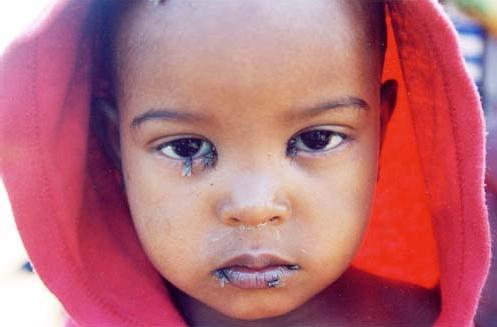
I'm reluctant to put up the pictures I have found of the flies, partly because they're so small but mostly because they make me sad, always showing them on beautiful kids:
I try to keep this blog quite light and funny, but on a purely emotional level pictures like this show why this sort of work is important. I find it very hard to understand how I live in a world with Ikea and Facebook and Angel boxsets and hazelnut latte, and on the same planet there are people living like this, who can't spare any of their two litres of water a day for washing, let alone spare 7p to buy soap.

M. sorbens adults feed on the dissolved salts and proteins in tears and snot, and in doing so transmit the bacterium responsible for trachoma. If you like looking at pictures of manky eyes (and hey, who am I to judge?) google trachoma, if you're eating your tea then don't. At first the infection seems just like conjuntivitis (or pinkeye for my American friends - who says you never learn anything from Southpark?) and eventually clears up on its own, making it pretty low on peoples' list of priorities. Repeated infections though cause scarring of the inner eyelid, causing it to contract and rolling the eyelashes inward so that they scrape the cornea whenever the sufferer blinks. As well as being excruciatingly painful, this scarring and possibly infection of the cornea leads to blindness. As it may be several decades between the initial infection and the development of trichiasis, people rarely associate the two.

The tragedy of all this is that flies seem to prefer the eyes of children to those of adults. There may be something in the tears and snot of children that's especially attractive to these flies or it may just be that, as anyone who's ever tried to get a four year old to blow their nose will tell you, kids are mucky little bastards and probably have rather more of the relevant secretions lying around. This is one of the things I'm hoping to find out. It has also been suggested in the same way that many other infections entities have evolved strategies to maximise their distribution (the cold virus makes you sneeze out an aerosol of cold viruses, the Guinea worm induces its victims to cool their burning sores in water into which it can release its young, if you have a Britney Spears song stuck in your head chances are you'll end up humming it and infect someone else), the trachoma bacterium may cause children's' eyes to water, attracting more flies to spread it. I'll also be looking at whether secretions from kids with trachoma are more attractive to flies than those of kids without (and any child found to have trachoma in the course of the study will get antibiotic treatment).

And this is the really sad thing - if you can't afford soap, you can't afford the really simple antibiotics to cure the results. As I may have observed on a previous occasion, the world's pretty messed up really.