Entomology, chemical ecology, evidence-based environmentalism and science in general. I like big bugs and I cannot lie.

Monday, 21 May 2012

Flour to the people!

 This post is written as an individual and all opinions within it are my own.  It is not the opinion of Rothamsted Research.

Yesterday a man was charged after breaking in to one of Rothamsted Research's experimental plots, attempting to damage plants used in an ongoing trial of wheat genetically modified to produce aphid alarm pheromone, the chemical aphids produce to warn others of danger.  The arrogance of his actions are truly astounding - what possible mandate could a single individual believe they have to destroy six years of publicly funded research?  But he is not alone, his actions were presumably inspired by a protest group called Take the Flour Back  which is proposing to destroy the trial next Saturday.

In response researchers at Rothamsted have taken the unusual step of appealing directly to these activists, in an open letter from John Pickett in New Scientist and a video appeal from Gia Aradottir:


John Pickett also appeared on Newsnight last week, and was barely able to get a word in edgeways (from 22 minutes).

Speaking as someone with more than a passing interest of science communication the strategy Rothamsted are persuing is fascinating - this is the first time I've seen seen scientists trying to engage protestors over the  strong values that have led them to protest, rather than assuming that they'll change their minds if provided with more facts.  Perhaps as a result. the news coverage of this particular scientific issue has been excellent, with the Guardian for example providing a contrasting point of view from a qualified scientist rather than whichever contrarian the journalist has on speed dial.  Speaking as a scientist, the prospect that this group can simply propose to stroll up and destroy years of vital work is deeply worrying.

Wheat is a vital crop, estimated in 2007 to provide 530 calories per person per day.  Over 650 million metric tonnes of wheat were produced in 2010 on almost 217 million hectares of land.  As these mindboggling figures show, wheat cultivation is vital to our ability to feed the world's population, and likely to become more so as the population increases.  Almost two million hectares are devoted to wheat cultivation in the UK alone.  We typically think of aphids as a minor nuisance, a threat to our kitchen windowsill coriander and broad beans, if we think of them at all but these innocous looking insects are capable of reducing wheat yields by up to 33% under the right circumstances 1 .  In the UK cereal insect outbreaks are typically treated with insecticides such as HallmarkZeon  or Aphox.

The grain aphid Sitobion avenae, image from Rothamsted Research
The need to provide food for an ever expanding world population in an increasingly unpredictable climate, whilst reducing the environmental damage caused by current industrial farming techniques, is something that Rothamsted scientist are just as concerend about as the environmental protestors planning on disrupting their work.  Indeed this trial, like so much of Rothamsted's other work, aims to provide practical tools to address these issues.  No one is denying that the current system of food distribution is thoroughly inequitable, that the fact that famines and "Man Vs Food" can exist on the same planet is obscene, that women desperately need access to the contraceptives they want to protect their health and plan their families or that we need urgent action on the greenhouse emissions making the climate less hospitable for agriculture year by year, but none of this will happen overnight.  In the short term we need new technologies, to feed more people from the same or even less land using fewer energy intensive and potentially environmentally damaging inputs like pesticides.  That is where this wheat comes in.


The wheat in this trial produces aphid alarm pheromone, an airborne signal which aphids use to alert others to danger. This deters other aphids from landing close by and may attract natural predators by informing them that there are injured aphids nearby which will make an easy meal.  This signalling system was "hacked" by plants in the mint family millenia ago, allowing them to naturally produce their own version of the pheromone which tricks aphids into thinking that they're a dangerous place to feed and so keeps them safe from predation.  The trial aims to see whether this protection can be introduced into wheat.

Aphids responding to alarm pheromone

There does seem to be quite a lot of misinformation out there about this trial - firstly, the wheat does not contain a cow gene.  What it contains is a synthetic promoter which has some sequence similarity to a cow promoter, which is not in fact the Laughing Cow's theatrical agent: a promoter is a short DNA sequence in front of a gene which tells the organism which circumstances to make the gene product under - at night say, or only in leaves.  If the gene product is a birthday cake, the gene could be theought of as the recipe for the cake and the promoter would be your diary with a list of bakeworthy friends' birthdays, telling you when to make the cake.  The cake in this case is the protein producing aphid alarm pheromone, the gene or recipe comes from a mint plant and the promoter had to be different from any promoters in the wheat already so the researchers could be sure it wouldn't be accidentally turned on in the wrong circumstances.  It's basically the equivalent of a lot of random Filofax pages which were bound together by the researchers into something which happened to ressemble the diary of a sentient cow who knew how to bake birthday cakes and owned a Filofax.  I'll stop there before I disappear up my own analogy, but you get the picture.

A number of measures have been taken to ensure that this wheat cannot escape into the wider environment. The variety of wheat selected for the trial is self pollinating, and the plot is surrounded by a buffer zone of barley, with which the wheat cannot cross-pollinate, far wider than the distance the heavy pollen can be blown ion the wind.  The fact that it is self pollinating also means that contrary to some concerns out there, pollinating insects like bees and butterflies are not exposed to gm pollen.

Concerns have also been raised about the possibility of apids evolving resistance to the alarm pheromone, citing the fact that insects evolve insecticide resistance.  This is extremely unlikely: not only have aphids been exposed to alarm pheromone produced by the mint family for millenia without deveoping resistance, but unlike the situation with insecticides evolving resistance to alarm pheromone would have significant costs to an aphid, making it less responsive to genuine alarm pheromone and hence at greater risk of becoming a tasty snack for passing ladybirds already chomping on its sisters.


Wheat fields, image from Rothamsted Research
A lot has also been made of the fact that this is spring wheat, not winter wheat which is more widely cultivated in the UK.  Somehow the fact that this is a preliminary trial doesn't seem to have been explained - this test in spring wheat is only to find out whether the modified plants do indeed suffer less aphid damage.  If this is inedeed the case the technology could be used in other varieties.

That's not to say there are no legitimate concerns about gm technology.  With antibiotic resistance on the rise the use of antibiotic resistance genes as markers is being phased out.  I presume an antibiotic resistance gene was used in this trial because it has been running for so long that it was started before alternatives became available but I have to admit that I don't know the reasoning behind this for certain.  However, as I noted above this is a preliminary trial to test whether the principle works, rather than the finished agricultural product - if this wheat were to be developed further I'm sure a different marker system would be used.  While the risks of horizontal gene transfer of antibiotic resistance genes into bacteria from this trial are not zero, they are negligible when compared with the large scale routine use of antibiotics in the meat industry.

You would be hard pressed to find anyone to argue that anything Monsanto has done is beneficial, but just because a technology has been used for profit with little concern for the environment doesn't mean the technology is inherently bad - a gun and a teaspoon are both made by metalwork but that does not mean they're used for the same thing2. The patenting of gene variants assosciated with breast cancer was recently overturned, but the fact that this particular technology was inappropriately commercialised doesn't invalidate the entire practice of genetic tests for disease.

Wheat field, image from Rothamsted Research
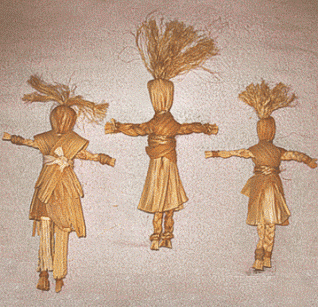
In the interests of full disclosure I should start be saying that I am a Phd student at Rothamsted.  Part of my funding is provided through Rothamsted, although it will stop being provided through Rothamsted at the end of May when I come to the end of my PhD, at which point it will be provided by two blindness charities and most probably my ability to stack shelves in a grocery store.  My work is nothing to do with this wheat project, but the aspect that concerns insect olfaction is partially supervised by John Pickett.  I realise this leaves me open to suggestions that I'm biased because I'm too close to this research, but I'm sure a lot of the people supporting Take Back the Flour are commintted environmentalists with jobs dedicated to improving sustainability - by that logic should they not be allowed to hold opinions on environmental matters? My connection to Rothamsted allows me to know a little bit about the project and the participants; it means that I know both John Pickett and Gia Aradottir, and know that they are fundamentally decent people who are not doing this out of malice or for personal profit. John Pickett has an infectious laugh, plays the trumpet in a local jazz band and is the sort of person who can't bear to see a penniless student in a pub without a drink, a situation which he will always seek to remedy.  He also knows a truly terrifying amount about how insects react to odours. Gia is one of the most compassionate people out there - she supported me when I had depression and I honestly don't think I would still be doing this PhD if it hadn't been for her.  I don't know Toby Bruce very well, but whenever I run into him in the kitchen he always asks me how my writeup is going, and I always say fine and smile uneasily.  In short, they are perfectly pleasant human beings who don't wander about in labcoats bulging with wads of industrial cash, zapping corn dollies with lightning to make make Frankenflour whilst cackling maniaically.

It lives! It lives!


I realise that I'm also open to the charge of hypocrisy, as my coeliac disease means I can't eat this genetically modified wheat or indeed any other wheat.  If wheat were ever genetically modified to be gluten-free though, you can bet I'd eat it like a shot.

I'm a scientist but also consider myself an environmentalist.  I first heard about Take the Flour Back from the newsletter of the Low Impact Living Initiative, to which I subscribe.  I have the full crunchy-granola starter kit of Keep Cup, Mooncap and garden wormery, and most importantly I know which goes where.  I grow garden veg, worry about food miles, carry my purchases from the People's Supermarket home by public transport in my reusable Turtle Bag, and keep rotting kitchen scraps for composting in a tin labelled "biscuits" to trick the unwary.

Watching Newsnight was an odd experience for me because the Take the Flour Back speaker, Jyoti Fernanades, is in many ways living my dream - she has a mixed smallholding in Dorset which she farms sustainably and teaches courses on.  I've always harboured a secret dream of finding some land in the west country, building a cob or strawbale house, planting a forest garden and keeping bees and silkworms, maybe some livestock.  If I'd encountered her in other circumstances I'd probably have considered her a fellow traveller, so it was strange to hear her on television espousing views that I disagree with entirely.  I'm also rather disappointed that Transition Heathrow, who are doing great things on an abandoned market garden near where I live, are supporting this action.

I'm not saying this to ask for a cookie (although a cookie would be nice, especially if it was made out of the afforementioned gluten-free wheat) but to demonstrate that it's possible to both be a scientist and care about the environment.  In fact it's not just possibly, I'm guessing it's common.

I care because I'm a human - the natural world is an incredibly beautiful place and nothing can approach the pleasure of walking the same route every day for years and watching it change through the seasons, from the bleak grey of winter through the merest hint of green to a riot of hawthorne and elder, or the joy of locking eyes with a robin whilst gardening and feeling, just for a fraction of a second, a moment of connection, or the awe I felt seeing the Milky Way from Africa, free of light pollution for the first time.  I plan on spawning some day,  and I want my theoretical future children to be able to experience that same wonder.  But I also care as a scientist - awe is magnified by understanding.

I remember the first time I learned about the water cycle and the nitrogen cycle in primary school, realising how nothing is created or destroyed but that we are all part of a finite closed system.  I remember the first time I saw an insect under a microscope at secondary school (oddly ebough it was a housefly), being astounded by the precise construction of this tiny living thing, with all it hairs and protrusions and graceful curves.  I remember thinking "Wow, if a fly looks like that what must I look like under a microscope?" and being so disappointed when I put my own finger under and found it to be featureless, realising for the first time that humans were not the most amazing things out there. I remember learning about evolution, the amazement I felt on realising that this blind, directionless system had designed beings that fit their environment so perfectly, the profound sense of connection I felt to the rest of the natural world on realising that all of us, earthworms and frogs and dandelions and amoebae and me, were built from the same basic building blocks by the same biochemical pathways.  The natural world is more incredible than we can possibly imagine, and personally I feel that anything but a scientific appreciation of it sells it short.

I seem to have spent much of this post finding "-ist" words I can use to describe myself: scientist, environmentalist, ecologist.  First and foremost though I'm a humanist - we are the only creatures on this planet who can feel that awe and wonder at the natural world and that makes us special, each and every one of the seven billion plus of us.  If all of us are to be fed on a finite planet, and not just enough to survive but to thrive and to have the same opportunity I have to rejoice in all the glory of nature, then something has to give and I strongly believe that an evidence-based approach, considering all the technologies available to us, is the best way to ensure that as little has to give as possible.


Sustainability: Rothamsted's carbon-capture experiments, image from Rothamsted Research
In conclusion, supporters of Take the Flour Back must realise that the scientists conducting this experiement are ordinary people concerned about feeding an ever-growing population whilst reducing damage to our shared planet, just like they are. We need to keep talking and listening, building rather than destroying, because we're all on the same side here.

Sense About Science is running a campaign appealing to these activists not to destroy this vital research.  You can sign the petition here.

Oakley, J.N., S.D. Wratten, A.F.G. Dixon and N. Carter. 1988. The Biology of Cereal Aphids. Home Grown Cereals Authority. Research Report No. 10.
It has been pointed out to me that you could, in fact, stir your tea with a small gun.

Thursday, 24 November 2011

Reboot

Well it’s been a while, to start with a bit of a blogging cliché. I took a bit of a break from blogging, and indeed from my PhD and much of my life, because of depression. I was going to write about the depression but then I realised you're here to read about insects and poo (at least I thought you were, though according to my page view statistics you're here to read about Crowded House and David Attenborough). If you really want to know what depression feels like I'd recommend reading this, which has to be one of the most heartbreaking things featuring pasta I've ever seen.

So I’m back at university, and I’m just about coping, and I’m going to see how far I can go. I want to get what I’ve done out there so it can be useful, and I’m assured that some of it would be publishable quality with a little bit more work, even if I have trouble believing that myself. Whether or not I go on to try for a PhD is a question for the future. I think that the focus of this blog will change a bit though; concentrating on my PhD to the exclusion of everything else probably contributed to my sprained brain, so I’m going to aim to write some more general entomological posts, reminding myself why I love this subject in all its multilegged glory in the first place. Hence the name change; I won't be doing any more fieldwork, and Geek in South West London doesn't have much of a ring to it.

Thursday, 28 April 2011

A quick plug

If anyone's been missing tales of bad weather and body odour in exotic locales, a friend of mine is cycling across South America at the moment. We're running a sweepstake on how long it takes him to become a Colombian drugs baron.

Wednesday, 25 August 2010

Dangers at dusk: is it time to move beyond bednets?

I originally wrote this for The Guardian's "Write the World" International development journalism competition. You can see the winning pieces here, some of which are excellent. I'd particularly recommend "Aid: Dead or alive?" for a more balanced discusion of the benefits and pitfalls of western aid than you usually find in the papers.

Cattle amble lazily back to their night time pastures as the sun sets over the tiny Gambian village of Wellingara. In dusty compound courtyards women stoke the fires that will cook the evening meal of rice and oily stews, while in the streets their husbands wait for their dinner, brewing tooth-achingly sweet attaya tea over charcoal braziers. As the coals smoulder and light-hearted banter or serious matters of village politics fill the evening air you could be forgiven for thinking this was one of the most tranquil places on earth. But all is not as peaceful as it appears.

“You can tell the people who are not from around here because they fight themselves” laughs Tumani, a fieldworker for The Gambia’s Medical Research Council, as he demonstrates how foreigners slap their faces and arms when they feel mosquitoes landing. Locals enjoying the relative cool of the evening know instead to brush the pests from exposed skin, their hands in continuous, fluid motion. Whatever strategies are employed against it though, early evening mosquito biting before people go to bed is a problem which mosquito nets are unable to tackle.

Uptake of bednets in The Gambia has been extraordinarily successful, with almost three quarters of households estimated to own at least one. Although malaria-focussed health education campaigns have doubtless increased their use, like the elaborately carved hardwood beds bought for newlyweds bednets have become something of a status symbol with perceived benefits that go far beyond malaria control. They catch detritus falling from traditional thatched roofs, provide a measure of privacy in a country where large extended families typically share a compound and are appreciated as interior decoration. In the local markets gaudily coloured nets swing in the breeze, adorned with lacy ruffles like some bizarre cross between a jelly fish and a wedding dress. While there are of course caveats – many of the locally produced nets are untreated with insecticides that protect people sleeping against the nets from bites, and the youngest children most vulnerable to malaria may not be the ones sleeping under the nets – with malaria infections and deaths in decline in The Gambia, this tiny country provides an encouraging example of what could be achieved by widespread adoption of insecticide-treated bednets.


Unfortunately it seems that in some areas bednets are becoming victims of their own success. The most effective nets are those treated with pyrethroid insecticides, but in some parts of Africa populations of mosquitoes are evolving resistance to pyrethroids and as treated nets become more common resistance will offer a greater survival advantage and so is likely to spread through the population.

Concerns are also emerging that malarial mosquitoes may be changing their behaviour to bite earlier in the evening before people are protected by nets. To complicate matters humans are also changing their behaviour; particularly in urban areas where development may bring electric light and flickering televisions beaming Brazilian telenovelas or Kung Fu movies to rapt audiences, people are staying up later after sundown and remaining exposed to mosquitoes for longer. Taking into consideration the fact that malaria is not the only disease transmitted by mosquitoes - the species that transmits yellow fever, for example, is active at dusk – the importance of preventing early evening biting becomes increasingly apparent.

Large-scale mosquito control programmes, such as those treating water sources where mosquitoes breed with chemical or biological insecticides, have had impressive results in some areas but require a great deal of political will, organisation and stability to scale up and so may not be appropriate everywhere. Instead the use of repellents, chemicals that smell unpleasant to mosquitoes, is being suggested as an approach that can be targeted at the household level as bednets can.

Tourists and travellers visiting malaria-endemic areas have long protected themselves with DEET, the plastic-melting personal repellent that can be rubbed on skin, and with the development of gentler personal repellents such as those derived from lemon eucalyptus oil there has been interest in extending the benefits to the local population. This work is in its early stages, but results from work in Bolivia on the effects of personal repellents in addition to nets are encouraging. However, as campaigns to promote handwashing with soap in Africa have shown, encouraging a change in habits is difficult and attempting to foster a culture of repellent use from scratch where none existed before would be challenging to say the least.

Another approach is the use of spatial repellents, odorous chemicals which disperse and so could make a wide area, for example the veranda of a house, unattractive to mosquitoes. Here signs are perhaps more encouraging; families in The Gambia already regularly burn mosquito coils or local herbs to deter evening biting insects, and as our knowledge of mosquito behaviour and biology increases we will be increasingly well placed to evaluate the effectiveness of these particular blends and to design new mixtures of odours and methods of delivering them.

Of course the use of repellents may simply provide a different pressure for mosquito populations to evolve their way around. Peaceful as the streets of Wellingara may appear as the tropical sun slips below the horizon, in the ongoing war between humans and mosquitoes they are in fact a battle ground.

Saturday, 7 August 2010

Home

I isolate the individual odours attractive to my flies from a complicated blend using a process called chromatography. Although this is done at Rothamsted with a fancy piece of equipment the basic principle is very simple: you have two different substances or "phases" which have different affinities for the different components of the blend you're trying to separate. The mobile phase, a gas or liquid, is passed over the stationary phase which could be a polymer or wax. Things with a greater affinity for the mobile phase will spend a greater proportion of the time in it, so will come out of the system faster than things with a greater affinity for the stationary phase. Use a long enough system and different constituents of a mixture will reliably come out separately, one after another.

The random chemistry lesson comes courtesy of a brilliant demonstration of the principles of chromatography that I saw at Gatwick airport on the way home. A mixed crowd of Gambians and British people got off the plane and started walking through the terminal building. We all walked together until we reached the first moving walkway, which interestingly the British people got on but the Gambians didn't. Three walkways later, the airport-sized chromatography system had acheived perfect of a mixed group of human beings on the basis of nationality with the Brits emerging 50 metres ahead of the Gambians.

So now I'm home, with my bloke and my family and my knitting and my tea and my 24 hour amenities and I'd be lying if I said it was anything other than a huge relief. Apologies to everyone I haven't been in touch with yet, I've needed a little time to recover but I plan to get in touch with all of you very soon. And everyone I have managed to speak to, even if it's just on facebook, thanks for the lovely welcome.

I think Hounslow Borough Council also wanted to welcome me back, I got home to find this poster on the bus stop on our street!